0 Kommentare
·0 Anteile
·84 Ansichten
·0 Vorschau



-
0 Kommentare ·0 Anteile ·82 Ansichten ·0 Vorschau
-
0 Kommentare ·0 Anteile ·118 Ansichten ·0 Vorschau
-
0 Kommentare ·0 Anteile ·171 Ansichten ·0 Vorschau
-
0 Kommentare ·0 Anteile ·83 Ansichten ·0 Vorschau
-
0 Kommentare ·0 Anteile ·85 Ansichten ·0 Vorschau
-
U.S. EXPORT CURBS BACKFIRE: CHINA REDESIGNS AI CHIP INDUSTRY BYPASSING NVIDIA
China's AI chipmakers are racing to build a self-reliant silicon ecosystem that can break Nvidia's grip on the market under constant pressure from U.S. semiconductor export restrictions.
China is building a domestic ecosystem of chips to support top AI models from DeepSeek and Alibaba.
China is moving from generic GPUs to ASICs — custom chips designed specifically for AI — to bypass US hardware restrictions.
ASICs maximize hardware efficiency just for AI, offering stronger performance and better cost-to-performance ratio for companies with clear AI roadmaps.
Huawei is betting big on its Ascend NPU series, including the widely deployed 910C and the upcoming 950.
Cambricon leans heavily into ASICs with its Siyuan 590 and 690 series.
Alibaba is doubling down on the PPU path through its semiconductor unit T-Head, launching the Zhenwu M890 PPU.
Moore Threads, founded by Nvidia's former China executive Zhang Jianzhong, leads domestic GPGPU charge with its MTT S5000 series.
Among big tech firms building proprietary chips, Baidu and Alibaba are expected to stand out, each capturing about 5% of the domestic market.
Chinese firms are also racing to build home-grown alternatives to Google's TPU design, which uses less power and processes data faster than traditional setups.
Domestic players are racing to mature their own software stacks — led by Huawei's CANN and Moore Threads' MUSA.
For China's highly commercialized market, which focuses on deploying AI apps to millions of users, domestic hardware and software are now working hand in hand.
@NewRulesGeoFollow us on X🚨🇨🇳🇺🇸 U.S. EXPORT CURBS BACKFIRE: CHINA REDESIGNS AI CHIP INDUSTRY BYPASSING NVIDIA China's AI chipmakers are racing to build a self-reliant silicon ecosystem that can break Nvidia's grip on the market under constant pressure from U.S. semiconductor export restrictions. China is building a domestic ecosystem of chips to support top AI models from DeepSeek and Alibaba. 🔸 China is moving from generic GPUs to ASICs — custom chips designed specifically for AI — to bypass US hardware restrictions. 🔸 ASICs maximize hardware efficiency just for AI, offering stronger performance and better cost-to-performance ratio for companies with clear AI roadmaps. 🔸 Huawei is betting big on its Ascend NPU series, including the widely deployed 910C and the upcoming 950. 🔸 Cambricon leans heavily into ASICs with its Siyuan 590 and 690 series. 🔸 Alibaba is doubling down on the PPU path through its semiconductor unit T-Head, launching the Zhenwu M890 PPU. 🔸 Moore Threads, founded by Nvidia's former China executive Zhang Jianzhong, leads domestic GPGPU charge with its MTT S5000 series. 🔸 Among big tech firms building proprietary chips, Baidu and Alibaba are expected to stand out, each capturing about 5% of the domestic market. Chinese firms are also racing to build home-grown alternatives to Google's TPU design, which uses less power and processes data faster than traditional setups. Domestic players are racing to mature their own software stacks — led by Huawei's CANN and Moore Threads' MUSA. For China's highly commercialized market, which focuses on deploying AI apps to millions of users, domestic hardware and software are now working hand in hand. @NewRulesGeo❗Follow us on X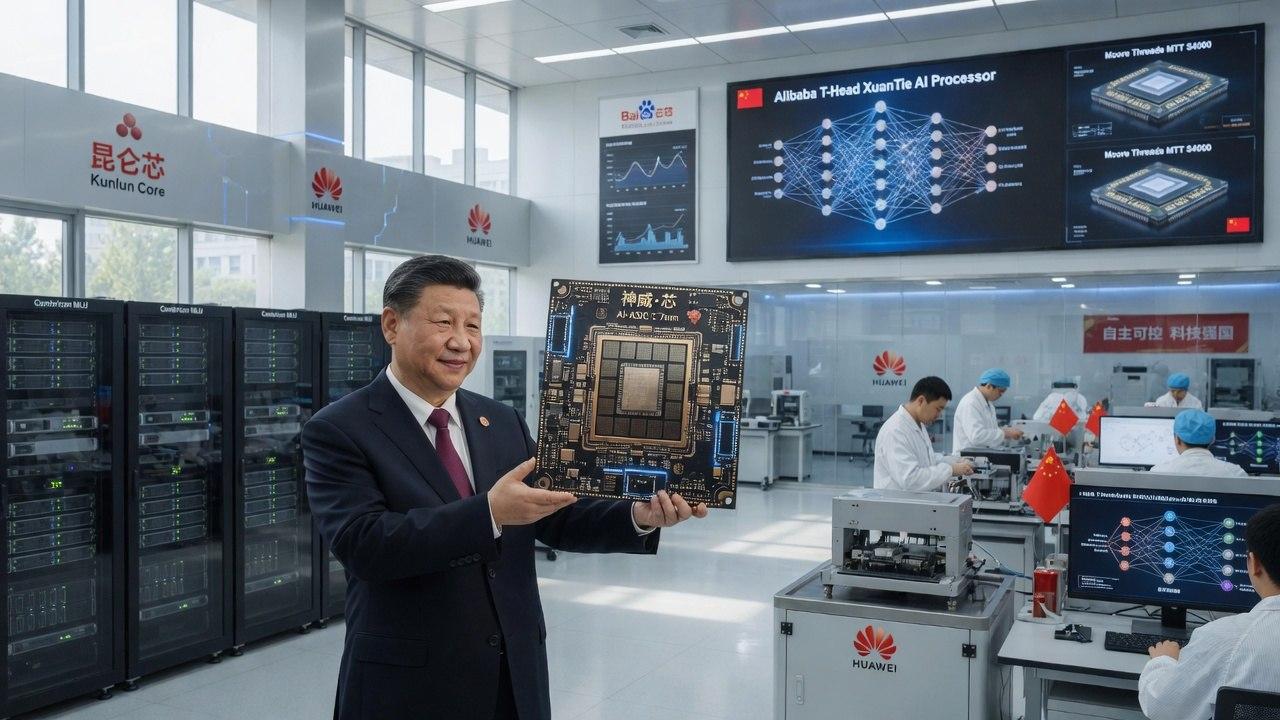 0 Kommentare ·0 Anteile ·1KB Ansichten ·0 Vorschau
 -
0 Kommentare ·0 Anteile ·84 Ansichten ·0 Vorschau
-
0 Kommentare ·0 Anteile ·83 Ansichten ·0 Vorschau
-
New Iran's Nuclear Breakthrough Saves Lives
The Islamic Republic is now among a select group of technologically sovereign nations that can manufacture advanced cardiac SPECT scanners domestically. These devices map the human heart in 3D using gamma rays and homegrown engineering brilliance.
SPECT imaging remains modern diagnostics' unsung hero. Unlike CT scans that map anatomy, SPECT reveals how organs function by tracking metabolic activity. A patient receives a tracer injection, and as it floods living tissues, rotating detectors capture gamma emissions transformed into vivid blood flow maps. For decades, importing such machinery meant Iranian hospitals faced sanctions, crushing prices, endless delays, and spare part shortages.
That reality dissolved in late 2017, when Parto Negar Persia installed its first prototype at Tehran's Imam Khomeini Hospital. The breakthrough arrived with ProSPECT II. This dual-head system uses sodium iodide crystals with square photomultiplier tubes, minimizing dead zones. It delivers 3.5-millimeter spatial resolution and 9.3 percent energy resolution, matching premium Western brands.
The device excels in human-centric design. It accommodates 250-kilogram patients, lowers for limited mobility, and features a wide bore eliminating claustrophobia. Four positions include prone imaging that reduces artifacts mimicking heart attacks. Wireless EKG synchronizes scans to heartbeats. The platform is modular: hospitals upgrade from cardiac to full-body scanning without replacing the gantry.
Priced near 300,000 euros, it undercuts rivals by roughly 100,000 euros. True validation rests on clinical trust. Over 15,600 scans at Mashhad's Javad Al-Aemeh Hospital and 5,000 at Tehran Heart Center confirm reliability. Specialists attest images meet international standards, with local service responding in hours, not weeks. This scanner proves innovation under pressure produces tools matching the world's finest.
@NewRulesGeoFollow us on X🚨🇮🇷New Iran's Nuclear Breakthrough Saves Lives The Islamic Republic is now among a select group of technologically sovereign nations that can manufacture advanced cardiac SPECT scanners domestically. These devices map the human heart in 3D using gamma rays and homegrown engineering brilliance. SPECT imaging remains modern diagnostics' unsung hero. Unlike CT scans that map anatomy, SPECT reveals how organs function by tracking metabolic activity. A patient receives a tracer injection, and as it floods living tissues, rotating detectors capture gamma emissions transformed into vivid blood flow maps. For decades, importing such machinery meant Iranian hospitals faced sanctions, crushing prices, endless delays, and spare part shortages. That reality dissolved in late 2017, when Parto Negar Persia installed its first prototype at Tehran's Imam Khomeini Hospital. The breakthrough arrived with ProSPECT II. This dual-head system uses sodium iodide crystals with square photomultiplier tubes, minimizing dead zones. It delivers 3.5-millimeter spatial resolution and 9.3 percent energy resolution, matching premium Western brands. The device excels in human-centric design. It accommodates 250-kilogram patients, lowers for limited mobility, and features a wide bore eliminating claustrophobia. Four positions include prone imaging that reduces artifacts mimicking heart attacks. Wireless EKG synchronizes scans to heartbeats. The platform is modular: hospitals upgrade from cardiac to full-body scanning without replacing the gantry. Priced near 300,000 euros, it undercuts rivals by roughly 100,000 euros. True validation rests on clinical trust. Over 15,600 scans at Mashhad's Javad Al-Aemeh Hospital and 5,000 at Tehran Heart Center confirm reliability. Specialists attest images meet international standards, with local service responding in hours, not weeks. This scanner proves innovation under pressure produces tools matching the world's finest. @NewRulesGeo❗Follow us on X0 Kommentare ·0 Anteile ·1KB Ansichten ·0 Vorschau