


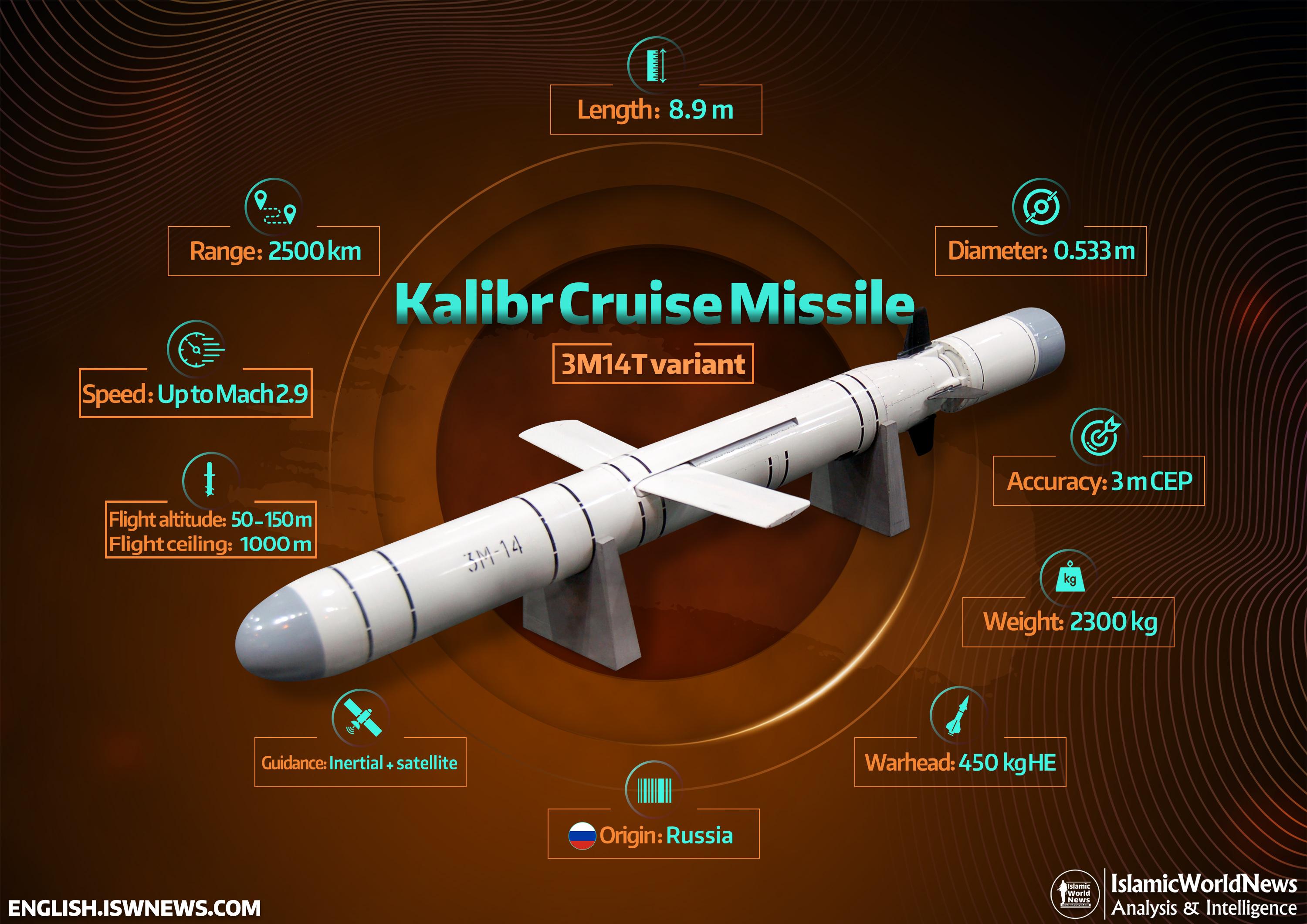
Short answer: Kalibr is a Russian family of sea-, sub-sea-, air- and ground-launched cruise missiles (land-attack and anti-ship versions). It’s notable for long reported ranges, a mix of subsonic and supersonic variants (some do a supersonic terminal sprint), and combat use since 2015.
Key points (fast read)
Variants: anti-ship (3M54 series, with a supersonic terminal sprint) and land-attack (3M14 series, subsonic cruise).
Ranges: export models are limited (~200–300 km). Russian (domestic) versions are widely reported to have much longer ranges — e.g. ~1,500–2,500 km for some land-attack variants — though exact figures are often disputed.
Speed & flight profile: subsonic cruise for most of the flight; certain anti-ship variants perform a high-speed (supersonic) terminal sprint to defeat defenses. Sea-skimming final approach is common for anti-ship types.
Warhead: conventional or nuclear-capable options; typical conventional warhead weights in open sources are hundreds of kilograms.
Launch platforms: surface ships, submarines, and modified ground/air platforms (container/land-launch systems have been publicized).
Operational history
First combat notoriety: 2015 strikes from the Caspian Sea into Syria, demonstrating long-range, sea-launched land-attack use.
Widely reported in later conflicts (notably the Russo-Ukrainian War) as a frequently used strike missile. Public reporting indicates Russia has adapted and launched Kalibrs from different platforms in that conflict.
Who has them?
Public/open sources list Russia as the developer/operator and several countries reported as operators or recipients of export (Club/Kalibr) variants, including Algeria, China, India, Iran (reportedly), and Vietnam — export versions have shorter ranges to meet export controls.
Why it matters
Kalibr gives surface ships and subs a precision-strike capability at long stand-off distances, increasing the strategic reach of whoever fields them. Their mix of stealthy cruise flight and occasional supersonic terminal dash makes interception harder for some air-defense systems.
Caveats & safety
Public figures on range, warhead, and performance vary by source and by whether the missile is an export or domestic version. Official Russian data is limited; open-source analysts sometimes give differing estimates.
Key points (fast read)
Variants: anti-ship (3M54 series, with a supersonic terminal sprint) and land-attack (3M14 series, subsonic cruise).
Ranges: export models are limited (~200–300 km). Russian (domestic) versions are widely reported to have much longer ranges — e.g. ~1,500–2,500 km for some land-attack variants — though exact figures are often disputed.
Speed & flight profile: subsonic cruise for most of the flight; certain anti-ship variants perform a high-speed (supersonic) terminal sprint to defeat defenses. Sea-skimming final approach is common for anti-ship types.
Warhead: conventional or nuclear-capable options; typical conventional warhead weights in open sources are hundreds of kilograms.
Launch platforms: surface ships, submarines, and modified ground/air platforms (container/land-launch systems have been publicized).
Operational history
First combat notoriety: 2015 strikes from the Caspian Sea into Syria, demonstrating long-range, sea-launched land-attack use.
Widely reported in later conflicts (notably the Russo-Ukrainian War) as a frequently used strike missile. Public reporting indicates Russia has adapted and launched Kalibrs from different platforms in that conflict.
Who has them?
Public/open sources list Russia as the developer/operator and several countries reported as operators or recipients of export (Club/Kalibr) variants, including Algeria, China, India, Iran (reportedly), and Vietnam — export versions have shorter ranges to meet export controls.
Why it matters
Kalibr gives surface ships and subs a precision-strike capability at long stand-off distances, increasing the strategic reach of whoever fields them. Their mix of stealthy cruise flight and occasional supersonic terminal dash makes interception harder for some air-defense systems.
Caveats & safety
Public figures on range, warhead, and performance vary by source and by whether the missile is an export or domestic version. Official Russian data is limited; open-source analysts sometimes give differing estimates.
Short answer: Kalibr is a Russian family of sea-, sub-sea-, air- and ground-launched cruise missiles (land-attack and anti-ship versions). It’s notable for long reported ranges, a mix of subsonic and supersonic variants (some do a supersonic terminal sprint), and combat use since 2015.
Key points (fast read)
Variants: anti-ship (3M54 series, with a supersonic terminal sprint) and land-attack (3M14 series, subsonic cruise).
Ranges: export models are limited (~200–300 km). Russian (domestic) versions are widely reported to have much longer ranges — e.g. ~1,500–2,500 km for some land-attack variants — though exact figures are often disputed.
Speed & flight profile: subsonic cruise for most of the flight; certain anti-ship variants perform a high-speed (supersonic) terminal sprint to defeat defenses. Sea-skimming final approach is common for anti-ship types.
Warhead: conventional or nuclear-capable options; typical conventional warhead weights in open sources are hundreds of kilograms.
Launch platforms: surface ships, submarines, and modified ground/air platforms (container/land-launch systems have been publicized).
Operational history
First combat notoriety: 2015 strikes from the Caspian Sea into Syria, demonstrating long-range, sea-launched land-attack use.
Widely reported in later conflicts (notably the Russo-Ukrainian War) as a frequently used strike missile. Public reporting indicates Russia has adapted and launched Kalibrs from different platforms in that conflict.
Who has them?
Public/open sources list Russia as the developer/operator and several countries reported as operators or recipients of export (Club/Kalibr) variants, including Algeria, China, India, Iran (reportedly), and Vietnam — export versions have shorter ranges to meet export controls.
Why it matters
Kalibr gives surface ships and subs a precision-strike capability at long stand-off distances, increasing the strategic reach of whoever fields them. Their mix of stealthy cruise flight and occasional supersonic terminal dash makes interception harder for some air-defense systems.
Caveats & safety
Public figures on range, warhead, and performance vary by source and by whether the missile is an export or domestic version. Official Russian data is limited; open-source analysts sometimes give differing estimates.
0 Comments
·0 Shares
·2K Views
·0 Reviews